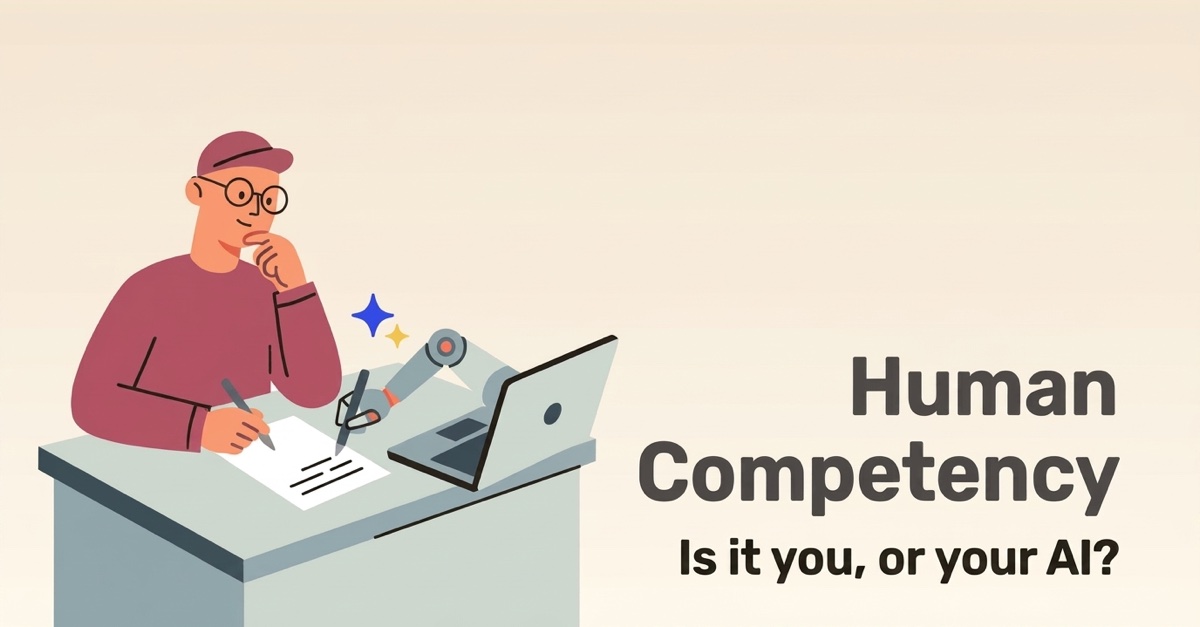
Human Competency
Here’s a question I keep coming back to: when I read something someone sent me, am I reading them, or am I reading their AI?
A few years ago, a well-written document told you something about the person behind it. They understood the problem well enough to explain it, they had read enough to cite it, and they cared enough to structure it. Writing was a reasonably honest signal of competency.
That signal is getting very noisy.
Reading and writing are the foundation
Almost everything we do at work sits on top of two basic skills: reading and writing.
We read to understand: specs, research, feedback, code, contracts, emails. We write to show we understood: proposals, summaries, designs, decisions, replies.
Right now, a big chunk of both is being handed over to AI.
- A long document arrives. “Summarize this for me.”
- A reply is needed. “Write a response to this.”
- A strategy deck is due. “Draft the narrative.”
Read in, write out, and the human in the middle may never have actually engaged with the material. Copy, paste, send.
That’s the part I find tricky. Not that people use AI (I use it all the time) but that from the outside, you can no longer tell where the person ends and the machine begins.
Competent human, or human with a great machine?
Picture two people who hand you the same polished write-up.
Person A read the source material, formed an opinion, and used AI to tighten the wording.
Person B pasted the source into an AI, asked for a write-up, skimmed it, and hit send.
The output looks identical. The competency behind it is not even close.
Person A can defend every sentence. Person B can defend almost none of them, and may not even know which sentences are wrong.
Where are the hallucinations?
This is where it gets risky. When AI reads on your behalf, it can misread. When it writes on your behalf, it can invent. Hallucinations usually aren’t obvious. They show up as a confident number that was never in the source, a quote nobody said, or a summary that quietly drops the one caveat that mattered.
If you never read the original, you have no way of catching it.
And now stack it. Someone’s AI writes a document. Someone else’s AI summarizes it. A third person’s AI drafts a reply to the summary. At each step a small error can creep in, and no human in the chain actually read the thing. It’s a game of telephone where every player is very articulate and nobody is listening.
So what is human intelligence now?
If reading and writing, the most basic layer of knowledge work, can be outsourced, then maybe competency moves up a level. A few things I think still clearly belong to humans:
- Judgment. Knowing which output is right, which is wrong, and which is confidently wrong.
- Taste. Knowing what good looks like before the machine shows you options.
- Verification. Going back to the source when it matters. Reading the actual document, not the summary of the summary.
- Accountability. Putting your name on something and being able to stand behind every line of it.
- Asking the right question. The prompt is only as good as the person’s understanding of the problem.
Notice that every one of these still depends on being able to read and think deeply. You can’t judge a summary of something you’ve never understood. You can’t spot a hallucination in a field you’ve never learned.